Gian.coolGianfranco's blog
A live, growing waveform for streaming audio with wavesurfer.js
Read more →AI wrote this article.
I was streaming text-to-speech (Gemini’s
gemini-3.1-flash-tts) over SSE. I wanted wavesurfer.js to draw the waveform live as PCM chunks arrived: grow left→right toward the full length and colour the played portion, instead of waiting for a final file.Here’s the result: a synthesized clip that plays in your browser without downloading an audio file.
3dvibegame.com
Read more →A 3d game where you create any object by text
The idea began with a question: What if an LLM can create any 3d object in an open world? And would that look like for players? Imagine in Minecraft or … where anybody you create your own car, jetpack, house or anything you can imagine. An trully open world.
How should we build this
The next question is how to build this. There are several options for a 3d game these days, from web and threejs to desktop games using game engines like Unreal or … Since I have a background on Web development, I decided to first see how build a 3d game for the web. I’ve never done a game and neither a 3d game or even a multi-player game – but since with AI coding I’ve been able to build mini desktop apps in rust, and CLI apps in go. I thought I’d give it a go with the help Codex and similar tools.
How does the game look like?
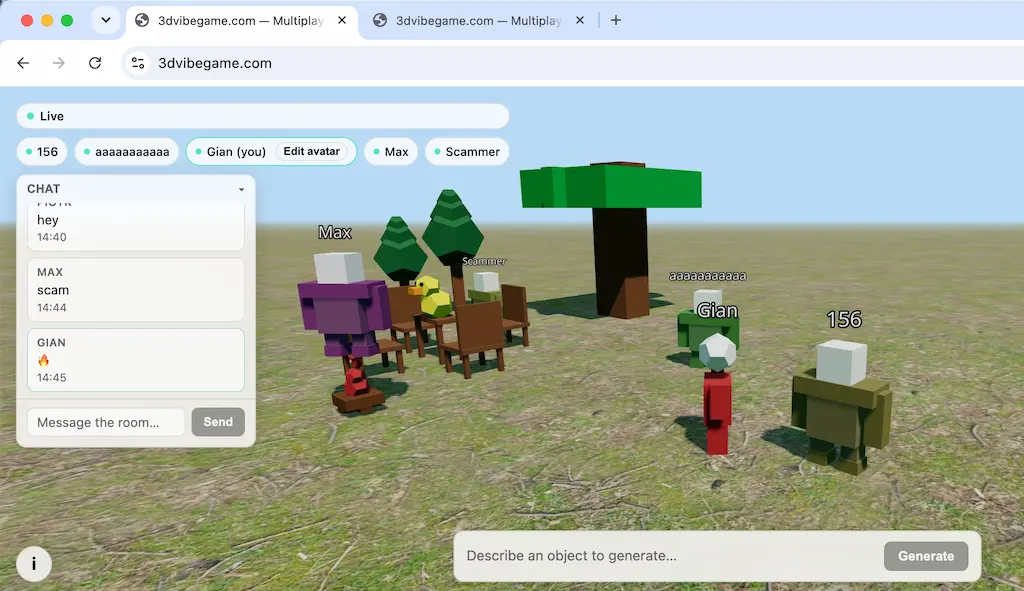
Here’s what it looks like when multiple people play. They can move around, change their avatar with AI or create or edit any objects.
There is basic collision engine between you and the objects but you can’t bump into other players. And there’s only one world. The idea is to add a lobby soon where you can create your own world and set different rules. Invite others and get crazy :)
Small coding models on Terminal-Bench 2
Read more →Updated on: June 4th 2026
Original date: Feb 26th 2026Frontier models get most of the headlines, but the more interesting race is happening one tier down. Here’s how open-weight and smaller models stack up on Terminal-Bench 2.0.
Benchmark ComparisonSmall Coding Models
Terminal-Bench 2.0Source: Terminal-Bench 2.0 leaderboard. All Qwen3.5 MoE models use activated parameter counts (A-suffix). K2.5-1T-A32B is a 1T-parameter sparse MoE from Moonshot AI with 32B active parameters.
AgentCaller: a phone layer for AI agents
Read more →AI agents are getting pretty good at the internet.
They can search, compare options, fill out forms, click through workflows, send emails, and call APIs. But much of the real world still sits beyond their reach, behind a channel most agents cannot use: the phone network.
That is the idea behind AgentCaller.io, a product I am testing now.
The pitch is simple: let a user’s AI agent call businesses, handle the conversation, and return a structured result the agent can act on.
Not a human call center. Not a browser automation hack. A phone interface built for agents.
Opus 4.6 vs GPT Codex 5.3 vs GPT 5.4
Read more →Updated to include GPT-5.4 and Gemini 3.1 Pro
A comparison of benchmark metrics between Opus 4.6 and Codex 5.3 models.
Anthropic and OpenAI both recently published Terminal-Bench 2.0 results, but in separate charts and a table. I wanted the full picture, so I combined them.
Benchmark ComparisonAgentic Coding
Terminal-Bench 2.0Note: All OpenAI models shown at xhigh compute setting. GPT-5.2-Codex appears twice — 64.7% as reported by Anthropic, 64.0% as reported by OpenAI. Harnesses differ: Anthropic & Google used the Terminus-2 harness; OpenAI used Codex. Scores are not directly comparable across providers.
I Built a Desktop Audio Converter With Claude Code
Read more →I’ve been meaning to build this app, and I actually started around this time last year. But after learning how to “code” or build with AI coding agents like
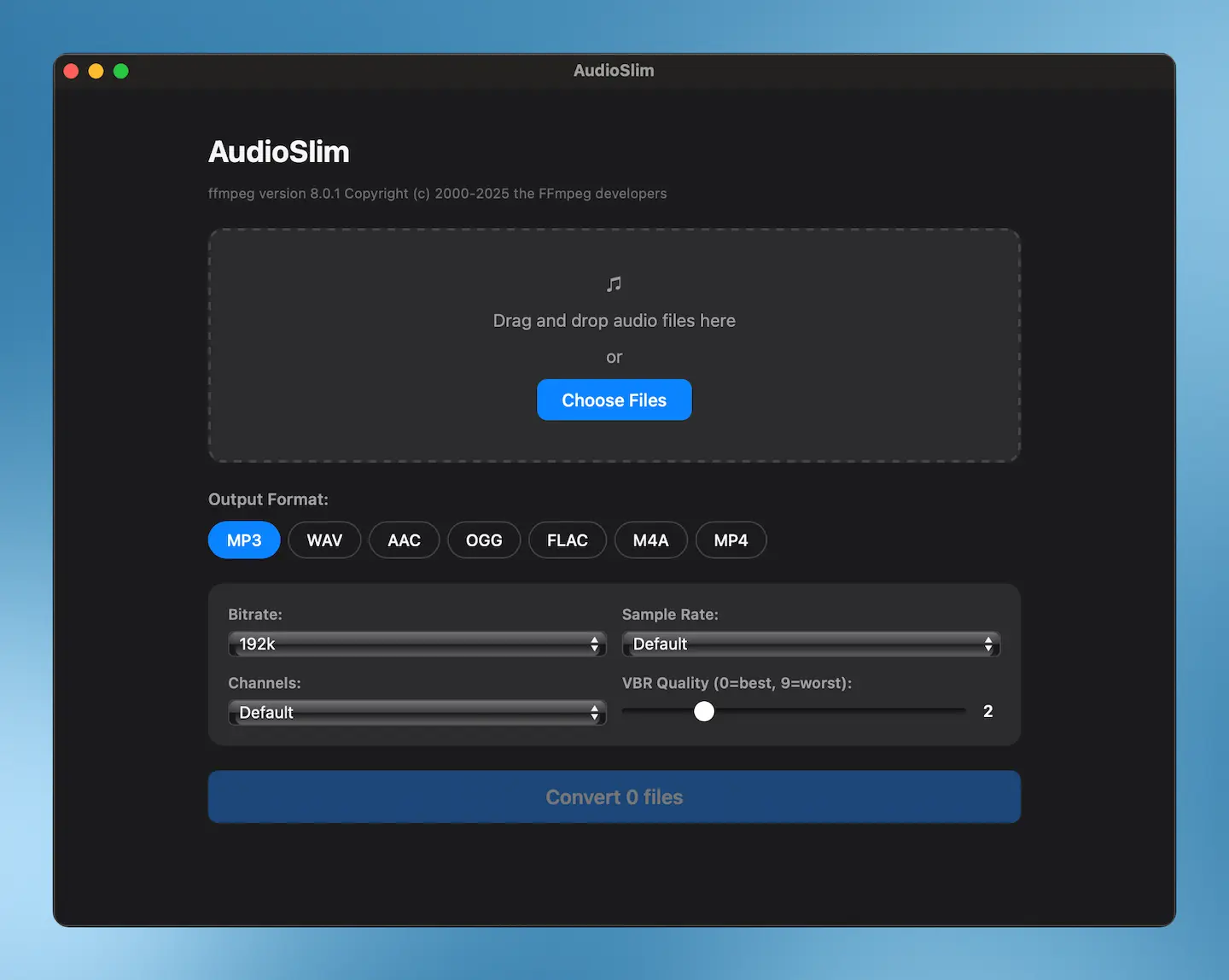
claudecode, I just gave it this prompt:plan how to complete this app. it should allow one or multiple files to be selected or dragged (audio only) and then it should show a box to select which format to convert to e.g mp3, wav, aac,ogg, flac,m4a, mp4) plus certain options that come from ffmpeg to compress the file
It wrote this comprehensive plan. And the it went for it. I asked a small question to fix a small UI color issue. And voila!
A(I) built Audioslim, a native macOS app that converts audio between MP3, WAV, AAC, OGG, FLAC, M4A, and MP4. I built it with claude code, Anthropic’s AI coding assistant for the terminal.